Last week's Blog dealt with Civil War veteran Richard Walton's obituary that, after scrutiny, proved largely untrue. It showed that we can not always trust the printed word. This seems to run contrary to our sensibilities, as many people subscribe to the proposition that anything printed in a newspaper must be true.
I have often encountered this belief. Years ago, I taught 7th and 8th grade Social Studies, mostly American History. Part of the curriculum was the teaching of current events which entailed the students cutting out news articles and discussing them in class. Occasionally, a student would bring in an article cut out from the National Inquirer newspaper which was a super market tabloid that printed articles designed to appeal to the more gullible elements of society. Many of the stories dealt with "true" UFO landings, two headed dogs, the Loch Ness Monster, and a wide variety of outlandish happenings. The ridiculously untrue articles were obviously printed merely to sell newspapers, and the truth be damned.
The National Inquirer has gone out of business since my teaching days, so I don't have a sample of that newspaper to illustrate my point; however, you'll get the idea from an equivalent tabloid from the late 1990's as shown below.
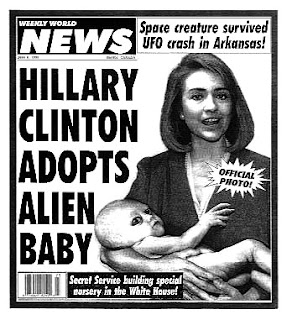
As ridiculous as it may seem, one of my students might have brought in the Hillary article for current events and insisted that it was true. After all, it's printed in a newspaper, the photo is clearly labeled as an OFFICIAL PHOTO, and why would the Secret Service be building a nursery in the White House if it weren't true?
Well, it seems that people's appetites for and willingness to believe unusual stories is not a new phenomena. A few weeks ago Rich Watson, a history colleague and member of the West Jersey History Round Table, brought a 1896 article printed in a Chicago newspaper to my attention. It was about Calico, a long forgotten town tucked away in the New Jersey Pinelands. It was located in Bass River Township, just down the road a piece from the old iron furnace town of Martha and not far from the old paper town of Harrisville.
I have often encountered this belief. Years ago, I taught 7th and 8th grade Social Studies, mostly American History. Part of the curriculum was the teaching of current events which entailed the students cutting out news articles and discussing them in class. Occasionally, a student would bring in an article cut out from the National Inquirer newspaper which was a super market tabloid that printed articles designed to appeal to the more gullible elements of society. Many of the stories dealt with "true" UFO landings, two headed dogs, the Loch Ness Monster, and a wide variety of outlandish happenings. The ridiculously untrue articles were obviously printed merely to sell newspapers, and the truth be damned.
The National Inquirer has gone out of business since my teaching days, so I don't have a sample of that newspaper to illustrate my point; however, you'll get the idea from an equivalent tabloid from the late 1990's as shown below.

As ridiculous as it may seem, one of my students might have brought in the Hillary article for current events and insisted that it was true. After all, it's printed in a newspaper, the photo is clearly labeled as an OFFICIAL PHOTO, and why would the Secret Service be building a nursery in the White House if it weren't true?
Well, it seems that people's appetites for and willingness to believe unusual stories is not a new phenomena. A few weeks ago Rich Watson, a history colleague and member of the West Jersey History Round Table, brought a 1896 article printed in a Chicago newspaper to my attention. It was about Calico, a long forgotten town tucked away in the New Jersey Pinelands. It was located in Bass River Township, just down the road a piece from the old iron furnace town of Martha and not far from the old paper town of Harrisville.

1858 Kuhn-Janney map of Burlington County
with the approximate location of CALICO added
The headline and subject matter of the article is clearly designed to attract a reader's interest - just the type of article that sells newspapers! It is a more subtle approach than the National Inquirer and quite believable, as it was tucked in with other news of the day.


A review of Henry Bisbee's transcription of the Martha Furnace Diary, 1808-1815 reveals a single reference to neighboring Calico, in an interesting June 6, 1809 entry involving a whipping, probably of a Martha worker living in Calico. It suggests that Calico was settled, not by berry pickers as stated in the news article, but by laborers employed at the iron furnace in Martha.
Rained. John Luker Carting sand for the Furnace. Iron very high occasioned by stamped stuff. Peter Cox went out to Calico & whipped Jack Johnson. Bil. Williams settled and quit.
Very little is actually known about Calico. Henry Charlton Beck in his book, Forgotten Towns of Southern New Jersey, published in 1936, expressed frustration in his efforts to locate it. After three years of inquiry, he finally found two gentlemen who remembered Calico, Hugh O'Neill and Kirk Cramer. Hugh was born in a log cabin at Harrisville. Kirk worked at the Harrisville paper mill and was a grandson of Ellis Adams who had a farm in Calico.
Beck was able to arrange a trip with Hugh and Kirk to Calico. They met at Harrisville and followed the sugar sand roads to Martha and about two miles further to Calico.

The route from Harrisville to Calico
There Cramer pointed out the Jersey sandstone chimney of his grandfather's house, the sole sentinel overlooking the site of old Calico. That chimney does not exist, today.

John Milton Adams standing at the Ellis Adams chimney at Calico, 1939.
Photo courtesy of John Milton Adams
Photo courtesy of John Milton Adams
Locations of a few other homes could be deduced by the observance of shallow cellar holes and occasional small piles of brick. Cramer pointed to a spot across the road where he said George Mick lived with the Ryan family.

A Calico cellar hole.
2007 photo by Peter H. Stemmer
Calling Calico a hamlet or town is a stretch. There is no evidence that a store, school, or post office ever existed there. They did exist in neighboring Harrisville.
Calico was a scattered group of homes that likely started as a bedroom community for the workers of neighboring Martha Furnace which was built in 1793. After the furnace shut down in 1845, Calico's residents turned to wood cutting and cranberry picking. Some of its residents may have worked in the paper mill at Harrisville.
The article's reference to rats is puzzling to me. Rats would not be attracted to cranberry bogs as claimed in the article, and it is doubtful that the refuse from the small group of homes at Calico could sustain the numbers of rodents mentioned. Another explanation would be that the term "rats" was used to refer to muskrats. This terminology was common in the area. That would explain the rats attraction to the cranberry bogs. However, muskrats would not inhabit buildings as mentioned in the article, blizzard or no blizzard.
Paul Schopp, the most knowledgeable and respected South Jersey historian that I know, weighed in on the Calico rats as a story loosely based on facts and written to poke fun at the Pineys:
I do, however, strongly believe that much of this story is apocryphal in nature as a way of poking fun at people who lived in the Pine Barrens. I have read other examples of articles that embrace an attempt of entertainment value for readers. I think the correspondent included just enough factual information about Calico and its surrounds to provide an air of authenticity.
Did I find the Calico Rats story entertaining? I sure did! Do I believe it? Yeh, about as much as I believe that Hillary Clinton adopted an alien child. How about you?
Pete S
PS- When we hear the word calico we generally think of cats or cloth, but it is also another name for Mountain Laurel, a plant which is common in some areas of the Pine Barrens. I wonder if that could have some connection to the name given to that small hamlet just down the road from Martha Furnace.
PS- When we hear the word calico we generally think of cats or cloth, but it is also another name for Mountain Laurel, a plant which is common in some areas of the Pine Barrens. I wonder if that could have some connection to the name given to that small hamlet just down the road from Martha Furnace.